
How the Mosselmonitor® works
A living organism as the sensor, read out with simple and robust electronics, assessed by a microcomputer with adjustable criteria. Three layers that together form a reliable early-warning system.
The mussel is the sensor
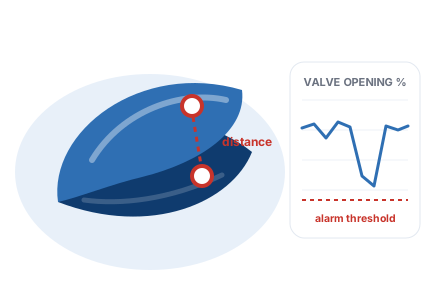
Mussels in clean water move their shell halves in a characteristic pattern: they are open most of the time, about 70 to 80%, to take in food and oxygen, and close only occasionally and briefly. When a contamination passes, that behaviour changes. The mussel detects the contamination and shows it in the way it moves.
Depending on the nature and the concentration of the substance, four deviating patterns are seen:
- Prolonged closing: the shell stays closed for a longer period
- Flapping: the mussel opens and closes far more often than normal
- Decreasing average: the average opening gradually drops
- Gaping: the shell stays open wider than normal and no longer moves, the sign that the mussel has not survived
The behaviour of every mussel is measured and assessed individually. Natural differences between animals therefore do not distort the picture, which would happen if the readings were averaged.
Which mussels?
Both freshwater and marine species are suitable. In fresh water, for example, the zebra mussel (Dreissena polymorpha), the painter's mussel (Unio pictorum) or the swan mussel (Anodonta cygnea); in salt water the common or blue mussel (Mytilus edulis). Other bivalves have also been used successfully.
Environmental factors
Not only chemical substances but also water temperature, pH and turbidity influence the behaviour of mussels. Where necessary these are measured as well. A temperature measurement is built into the Mosselmonitor as standard, so readings can be interpreted correctly.
Measuring without disturbing the mussel
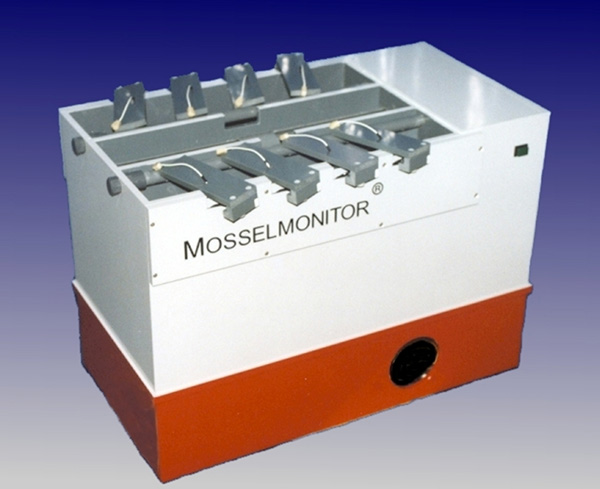
Two small coils are fitted to each mussel, one on each shell half. A high-frequency signal of 250 kHz is applied to one coil, generating a magnetic field. That field induces a voltage in the coil on the opposite shell half. The strength of that voltage depends on the distance between the coils and is therefore a direct measure of the valve position.
To prevent the eight measuring signals from influencing each other, they are transmitted one after the other and read only in the matching receiver (multiplexing). The signal is rectified, digitised through an A/D converter and processed by the microcomputer, which tests it against the assessment criteria.
An alarm situation is signalled through a potential-free alarm contact. Measurement data, alarms and evaluation values are available through the serial terminal port (RS422) for a PC running the Present IT software.
From raw reading to valve opening in percent
Every measuring cycle, adjustable between 10 and 600 seconds, the valve positions of all mussels are measured and assessed.
The raw reading differs from mussel to mussel: mussels are simply not all the same size, and the adjustment of the electronics plays a part as well. That is why the software determines, for each mussel, its own minimum (0%, closed) and maximum (100%, open) value and converts every reading into a valve opening in percent. This makes the behaviour of the different mussels comparable, despite differences in size and adjustment.
The criteria against which the behaviour is tested determine the sensitivity of the system. They are set through a built-in, menu-driven program, accessible with a terminal or PC. When the set limits are exceeded, the alarm contact closes.
In addition to the valve positions, the supply voltage and the water temperature are measured every cycle and made available over the serial connection. An internal memory keeps the data for evaluating trends.
The alarm types
At a glance
| Number of mussels | 8, each measured and assessed individually |
|---|---|
| Measuring principle | Inductive distance measurement with two coils per mussel (250 kHz), multiplexed |
| Measuring interval | Adjustable from 10 to 600 seconds |
| Outputs | Potential-free alarm contact; serial terminal port (RS422) for data and settings |
| Alarms | Closed, activity, decreasing average, gaping, low supply voltage; criteria adjustable by menu |
| Additional measurements | Water temperature and supply voltage, every cycle |
| Power | External backup UPS as standard; other power solutions can be supplied on request |
| Deployment | Fresh and salt water; field unit usable down to 15 metres |
| Software | Present IT for graphical display, storage and communication |
Specifications may vary by version. Compare the In-Situ and Flow-Through versions or download the datasheet (pdf).
Want to know more?
Ask us for more information, or tell us about your application so we can think along.